
Why New Brunswick? A Practical Guide for Canadians Considering a Move
If you are paying $2,200 a month for a one-bedroom in Toronto, working a job that barely covers your rent, and wondering what the point is, you are not alone. The average Canadian renter now spends more than 30% of their gross income on housing, a threshold that financial planners define as the entry point for housing stress. In Vancouver and Toronto, that number pushes past 50% for many households.
A growing number of Canadians are looking east for answers. New Brunswick's population grew by more than 5% between 2021 and 2023 according to Statistics Canada, one of the highest provincial growth rates in the country during that period. The people moving here are working-age adults and young families who ran the numbers and decided this province made more sense.
This is a realistic, data-grounded look at what life and work actually look like in New Brunswick, who is moving there, and why it might make more financial and professional sense than staying where you are.
The economic case: your dollar goes further here
New Brunswick consistently ranks among the most affordable provinces in Canada. The numbers below show the gap between the national conversation and the reality on the ground here.
That gap is not marginal. For many Canadians, it is the difference between renting indefinitely and actually owning a home within a reasonable timeframe. A household earning $80,000 in Moncton has substantially more purchasing power and saving capacity than the same household earning $80,000 in Vancouver. Use the calculator below to see how your specific situation compares.
Cost of living comparison calculator
Enter your current city and salary to see what that income would be worth in New Brunswick.
These numbers reflect real differences in housing, groceries, transportation, childcare, and taxes. A job offer at $55,000 in Moncton is a different proposition than a job offer at $55,000 in Calgary, once you account for what each city actually costs to live in.

The job market: what is actually available
New Brunswick's economy is more diverse than most outsiders expect. The province has long-standing strength in manufacturing, transportation, and skilled trades. It also has a growing service sector, an expanding healthcare system, significant investment in clean energy, and increasing demand in logistics and warehousing driven by e-commerce growth across Atlantic Canada.
The provincial unemployment rate has held below the national average for multiple consecutive quarters, and employers across sectors report ongoing difficulty filling skilled positions. That is useful context for workers with in-demand backgrounds. New Brunswick employers are competing for qualified candidates, and the hiring dynamic reflects it.
Integrated Staffing places candidates across New Brunswick in roles spanning:
If you have a trade ticket, a commercial driver's licence, or experience in production or industrial settings, your credentials transfer and your skills are in demand. New Brunswick also has some of the shortest certification reciprocity timelines in Canada for red seal tradespeople relocating from other provinces.
New Brunswick employers are recruiting people who are serious about building a career and a life in the province. That shift in the hiring dynamic creates real opportunity for workers who show up ready to commit.
The three cities: what life actually looks like
New Brunswick does not have one dominant city. It has three distinct ones, each with its own character, economy, and cost profile. Understanding the differences matters when deciding where to land.
Compare the cities
- + Fastest growing city in Atlantic Canada, with strong inbound migration from Ontario, BC, and internationally.
- + Major logistics and transportation hub, with national employers including Amazon, Costco, and Medavie Blue Cross operating here.
- + Largest commercial centre in NB, with the most diverse private sector job market of the three cities.
- + Young demographic and an active food, arts, and music scene, particularly in the Dieppe corridor and downtown.
- + Officially bilingual region, but English-only speakers live and work here comfortably. Bilingualism is an asset, not a requirement, in most private sector roles.
- – Housing prices have appreciated faster here than the other two cities due to demand. Still significantly more affordable than any major Canadian urban centre.
- + Provincial capital with a stable public sector base and a tech sector anchored by companies like Caris Life Sciences and Spielo.
- + Home to the University of New Brunswick, founded in 1785 and one of Canada's oldest universities, and St. Thomas University.
- + Regularly cited as one of the most walkable and livable small cities in eastern Canada, with a compact, well-maintained downtown core.
- + Outstanding outdoor lifestyle anchored by the Saint John River, Mactaquac Provincial Park, and a trail network that connects directly to the city.
- + Active arts and culture scene with the Beaverbrook Art Gallery, Harvest Jazz and Blues Festival, and a strong restaurant community relative to its population.
- – Smaller private sector industrial base than Moncton. Workers in trades and production may have a shorter list of local employers to choose from.
- + Home to some of the province's largest industrial employers, including Irving Oil, which operates the largest oil refinery in Canada by capacity at 320,000 barrels per day.
- + The most affordable housing market of the three cities, with a clear path to homeownership for working households at income levels that would rent indefinitely elsewhere.
- + Integrated Staffing has a direct office in Saint John, meaning candidates get local recruiter support and access to active job placements from day one.
- + The Port of Saint John is one of the busiest in eastern Canada, generating consistent demand for trades, logistics, and industrial labour year-round.
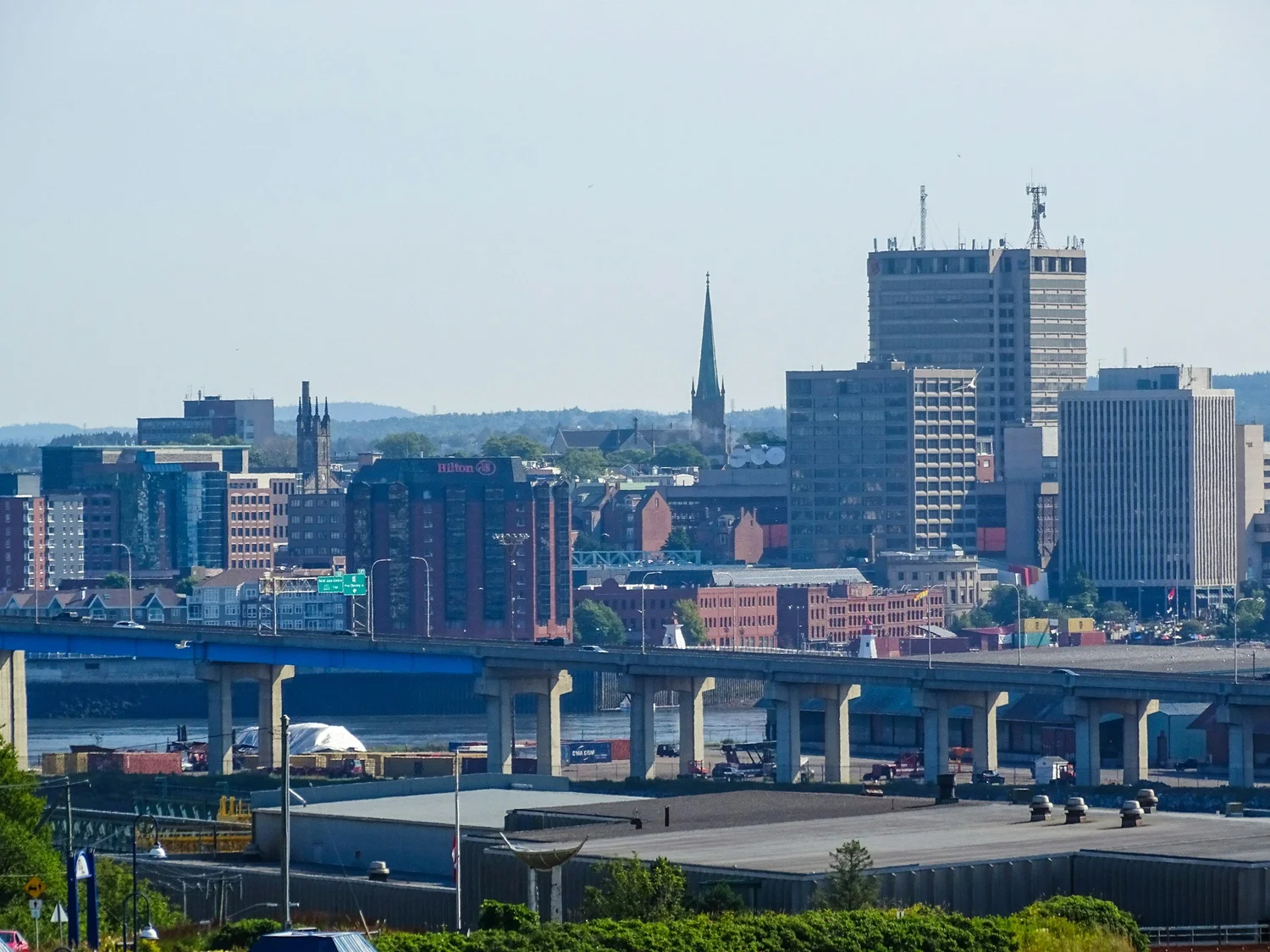
- + Downtown revitalization investment has been ongoing and visible, with new residential and commercial development concentrated in the uptown core.
- – Smaller social and cultural scene relative to Moncton. A stronger fit for workers who prioritize affordability and employment stability over city amenities.
Quality of life: what you actually do here
Housing costs and job listings tell part of the story. What keeps people in New Brunswick once they arrive is harder to quantify but easier to describe.
The average commute time in Moncton is under 20 minutes. In Fredericton it is under 18. Compare that to the Toronto average of 54 minutes each way, or Calgary's 27. Over a full working year, a Moncton commuter recovers roughly 250 to 300 hours that a Toronto commuter does not have. That time goes back to family, exercise, hobbies, or sleep.
New Brunswick has 2,250 kilometres of coastline. The Bay of Fundy, which borders the southern part of the province, produces the highest tides in the world, with a tidal range of up to 16 metres at Hopewell Rocks. Within a short drive of any of the three cities, you can be standing on a beach, hiking through old-growth forest, or kayaking a river system that has barely changed in a century. These are not long weekend trips. They are Saturday morning options for people who live here.
- Fundy National Park: 110 km of hiking trails, world-record tides, coastal camping
- Hopewell Rocks: tidal sculptures up to 15 metres tall, walkable at low tide
- Crabbe Mountain: downhill skiing and snowboarding 45 minutes from Fredericton
- Kouchibouguac National Park: barrier islands, warm lagoons, cycling trails on the Northumberland coast
- Miramichi River: one of the most renowned Atlantic salmon rivers in the world
- Cape Enrage: zip-lining and rappelling above the Bay of Fundy
- Fundy Trail Parkway: 100+ km of multi-use trail along the southern coastline
- Parlee Beach Provincial Park: one of the warmest saltwater beaches in Atlantic Canada
- Harvest Jazz and Blues Festival (Fredericton): one of the largest jazz festivals in Canada, running annually since 1992
- Beaverbrook Art Gallery (Fredericton): permanent collection includes works by Salvador Dali and Winston Churchill
- Magnetic Hill Music Festival (Moncton): has hosted the Rolling Stones, U2, and AC/DC on the same grounds
- Frye Festival (Moncton): bilingual literary festival with national profile
- New Brunswick Museum (Saint John): oldest continuously operating public museum in Canada, opened 1842
- Shediac Lobster Festival: one of the Maritime's most well-attended annual community events
- Lobster, scallops, and oysters available fresh and local year-round at prices significantly below major city market rates
- Moncton has a restaurant-per-capita density that far exceeds its size, with strong French, Vietnamese, and contemporary Canadian options
- Active craft brewing scene across all three cities, anchored by Picaroons (Fredericton) and Tide and Boar (Moncton)
- Farmers markets operating weekly in all three cities through summer and shoulder seasons
- Acadian food culture unique to this region, with dishes and culinary traditions found nowhere else in Canada
- Average childcare costs in NB are significantly below Ontario and BC averages under the federal $10/day program
- Lower student-to-teacher ratios in public schools compared to Ontario and BC provincial averages
- Neighbourhood scale means children have more independence and parents spend considerably less time in the car
- Crime rates in all three cities fall below the national average for comparable metropolitan areas
- Strong community volunteer culture and a pace of life that makes meaningful involvement in where you live actually feasible
The outdoor access draws people in. The pace of life keeps them. Workers who relocated from Toronto and Calgary consistently describe the same shift: they stopped spending their evenings recovering from the day and started using them for something. That sounds small until you experience the difference.

Immigration pathways: New Brunswick is actively recruiting newcomers
For newcomers to Canada, New Brunswick has built deliberate infrastructure to support settlement. The province runs the New Brunswick Provincial Nominee Program (NBPNP), with streams targeting skilled workers, international graduates, and workers already employed in the province who want to establish permanent residency. The Atlantic Immigration Program (AIP), a federal initiative covering all four Atlantic provinces, also provides a pathway specifically designed for employers who cannot fill skilled positions locally.
The provincial government has set an explicit target of growing the population to 900,000 by 2040 from roughly 820,000 today. Immigration is central to that plan, and the settlement programs reflect it. Moncton in particular has well-developed newcomer support services, with French and English language resources and a newcomer community that has grown substantially over the past five years.
The cost of living advantage also means the early years of building financial stability in New Brunswick are considerably less pressured than in Ontario or British Columbia. That matters for newcomers establishing credit, saving for a down payment, and building a financial cushion in a new country.
What makes a move like this work
Moving provinces is not trivial. It requires planning, financial runway, and ideally a job offer before you arrive. The candidates who make this transition successfully tend to share a few characteristics: they research the job market in their specific trade or field before committing, they connect with a recruiter who has real employer relationships in the province, and they give themselves a full year before drawing firm conclusions about whether the move was right.
Integrated Staffing has offices in both Moncton and Saint John and works with employers across New Brunswick in every sector listed above. If you are considering a move and want to know what roles are currently open in your field, getting in touch before you relocate puts you well ahead of candidates who wait until they arrive.
Ready to see what New Brunswick has open right now?
Browse current job openings across NB in various industries. Our teams in Moncton and Saint John are ready to help you.
Browse New Brunswick jobsSources: CMHC Rental Market Report 2024, Statistics Canada Census and population estimates, Numbeo Cost of Living Index, Canadian Real Estate Association (CREA) national price data.